2026-06-05
Introduction: Schwannomas are benign tumors arising from the Schwann cells of the nerve sheath. They may originate from any peripheral nerve, cranial nerve, or autonomic nerve. Trigeminal schwannomas are rare, accounting for 0.07–0.3% of all intracranial tumors and 0.8–5% of all intracranial schwannomas.
They may arise from the cisternal segment of the trigeminal nerve, from the trigeminal ganglion (Gasserian ganglion) within Meckel's cave, or from one of the nerve's three peripheral branches. Clinically, they typically present with facial pain, numbness, and paresthesia in the distribution of one or all three branches of the trigeminal nerve, depending on tumor location. MRI is the gold standard for evaluating trigeminal schwannomas, owing to its multiplanar capability and superior soft-tissue contrast. It plays a central role in both diagnosis and surgical planning.
Anatomy
The trigeminal nerve provides sensory innervation to the face and motor supply to the muscles of mastication. It can be divided into five segments: the intra-axial segment (within the brainstem), the cisternal segment, the Meckel's cave and cavernous sinus segment, the skull base segment, and the extracranial segment. The Gasserian ganglion lies within Meckel's cave and gives rise to three branches: the ophthalmic nerve (V1), the maxillary nerve (V2), and the mandibular nerve (V3).
Epidemiology and Clinical Presentation
Trigeminal schwannomas are uncommon tumors, accounting for 1–2% of all intracranial schwannomas. They occur predominantly between the ages of 40 and 60, with a slight female predominance. These are benign tumors with a slow and insidious clinical course, most commonly arising in the cisternal segment and growing slowly along the nerve's anatomical pathway.
Clinically, patients present with trigeminal nerve dysfunction. Facial pain is the most frequent symptom. Trigeminal neuralgia is a specific pain syndrome defined by the International Association for the Study of Pain as "sudden, usually unilateral, severe, brief, stabbing, recurrent pain in the distribution of one or more branches of the trigeminal nerve." Other common presentations include numbness or a burning sensation along the distribution of the nerve or one of its branches. Long-standing tumors may also produce motor symptoms such as difficulty chewing and jaw deviation.
Imaging
Imaging plays a critical role in diagnosis and preoperative planning. MRI is the preferred modality and is generally sufficient to establish the diagnosis in the appropriate clinical context. On MRI, these tumors are typically isointense to hypointense on T1-weighted sequences and hyperintense on T2-weighted sequences, with intense enhancement following gadolinium administration. On imaging, the lesion may occasionally appear as a mixed solid-cystic or predominantly cystic mass. In addition to standard MRI sequences, obtaining a thin-slice T2-weighted CISS 3D axial sequence is important in patients with clinical suspicion of trigeminal nerve pathology, as it provides superior visualization of the cisternal segment of the nerve.
CT scanning serves as a complement to MRI, particularly for tumors located at the skull base. On CT, these tumors typically appear as homogeneously enhancing masses with remodeling of the adjacent bone.
Illustrative Case
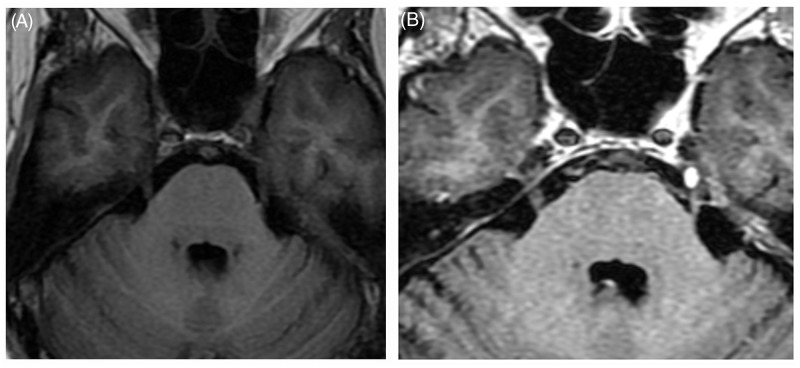
A 49-year-old woman presented with left-sided facial numbness. Axial pre-contrast T1-weighted (A) and post-contrast T1-weighted (B) MR images demonstrated a small, intensely enhancing lesion along the left cisternal segment of the trigeminal nerve, just proximal to Meckel's cave.
Summary
Intracranial trigeminal schwannomas are among the rarer intracranial tumors. They produce a characteristic clinical picture in patients presenting with trigeminal neuralgia-type symptoms. Imaging plays an indispensable role in both diagnosis and surgical planning. MRI is the modality of choice; CT serves as a complementary tool, particularly for skull base tumors.