2026-06-04
Introduction: Severe unilateral facial pain, progressive hearing loss, frequent dizziness or difficulty standing, facial muscle stiffness or impaired control of facial expression — when these symptoms appear, it is time to be on alert. Behind seemingly unrelated abnormalities may lie a single underlying condition: trigeminal schwannoma.
As a benign tumor originating from the Schwann cells of the trigeminal nerve — a primarily sensory cranial nerve, trigeminal schwannoma develops in a critical region of the skull base, in close proximity to the vestibular nerve, the cochlear nerve, and the motor facial nerve. As the tumor slowly enlarges, it compresses the surrounding neural structures, giving rise to the constellation of symptoms described above. What treatment options exist for trigeminal schwannoma, and how should treatment decisions be made? In this diagnostic and therapeutic contest, Professor Henry W.S. Schroeder — a member of the World Academy of Neurological Surgeons (WANG) under INC International Neurosurgical Group, and former chair of the Endoscopy Committee of the World Federation of Neurosurgical Societies (WFNS) — offers his expert perspective.
The "Three-Fingered Glove" and Its Ticking Time Bomb
The trigeminal ganglion is housed within Meckel's cave — a space formed by the dura mater and arachnoid membrane, shaped like a "three-fingered glove." Each "finger" corresponds to one branch of the trigeminal nerve.
• The ophthalmic branch (V1) travels along the lateral wall of the cavernous sinus and enters the orbit.
• The maxillary branch (V2) exits through the dura at the point where it merges with the medial wall of the cavernous sinus, and leaves the cranial cavity via the foramen rotundum.
• The mandibular branch forms the mandibular nerve, carrying both sensory fibers and motor fibers innervating the muscles of mastication.
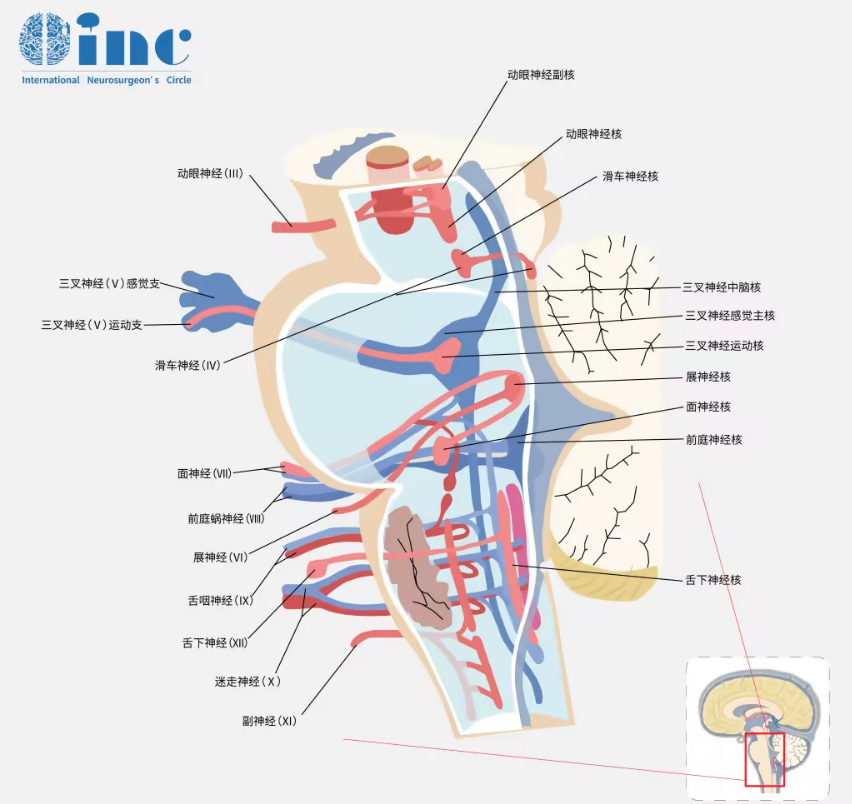
1. Facial pain (trigeminal neuralgia) Pain occurs within the distribution of the trigeminal nerve and is usually confined to one of its branches. It commonly affects the cheek, upper and lower jaw, teeth, gums, tongue, forehead, and the sides of the nose, and typically involves only one side of the face.
2. Hearing loss and rotational vertigo As the tumor enlarges and begins to affect the vestibulo-cochlear nerve complex, patients may develop related symptoms.
Note: Rotational vertigo — medically termed "true vertigo" or "peripheral vertigo" — is a common vestibular disorder in which patients perceive themselves or their surroundings as spinning or moving, even though no such movement is actually occurring.
3. Facial numbness or facial palsy Early manifestations are typically facial numbness; as the tumor progresses, facial palsy may develop as a serious late-stage complication.
4. Hydrocephalus In cases where the tumor reaches a very large size, it may obstruct the CSF pathways, leading to CSF retention and hydrocephalus. This can cause nausea and vomiting in the early stages, with impaired consciousness potentially developing later.
How Should the Three Treatment Options Be Chosen?
The treatment goal for trigeminal schwannoma is to achieve the maximum possible extent of tumor resection while preserving the patient's neurological function — all within the bounds of patient safety. Professor Schroeder identifies three main treatment options.
1. Watchful Waiting
For older patients, a conservative strategy of regular imaging surveillance is recommended — specifically, MRI every six to twelve months to monitor tumor growth dynamics. For small tumors that have not yet produced clinical symptoms, watchful waiting is also a reasonable management approach.
2. Surgery
For younger patients, surgical intervention is generally the preferred option, particularly for smaller tumors where resection can be achieved without causing permanent neurological complications.
For larger tumors exceeding 3 cm in diameter, surgery should be the first-line treatment, as radiotherapy may not be sufficient to arrest continued tumor growth. Furthermore, if a large tumor requires surgery after having already undergone radiotherapy, the operative complexity and risk are significantly increased owing to potential adhesion between the tumor and surrounding neurovascular structures.
Selecting the appropriate surgical approach is critically important — the goal is to achieve maximum tumor resection while minimizing the risk of complications.
A range of surgical techniques is currently available, including conventional craniotomy, pure endoscopic surgery, and endoscope-assisted craniotomy. With advances in microsurgical technique and skull base approaches, the surgical treatment of trigeminal schwannoma has become progressively safer; the risks of death and disability have been reduced, and tumor resection rates have improved.
3. Radiotherapy
When surgery is not feasible, radiotherapy serves as an adjunct for small to medium-sized tumors, postoperative residual tumor, or recurrent disease.
For trigeminal schwannomas that cannot be completely resected, surgical debulking followed by radiotherapy to control residual tumor is an approach that effectively reduces the risk of new cranial nerve deficits and improves overall patient outcomes.
Surgical Case Study: Dual-Scope Technique Achieves Complete Resection
A 57-year-old patient presented with left-sided facial numbness. MRI demonstrated a trigeminal schwannoma approximately 2 cm in diameter in the cerebellopontine angle.
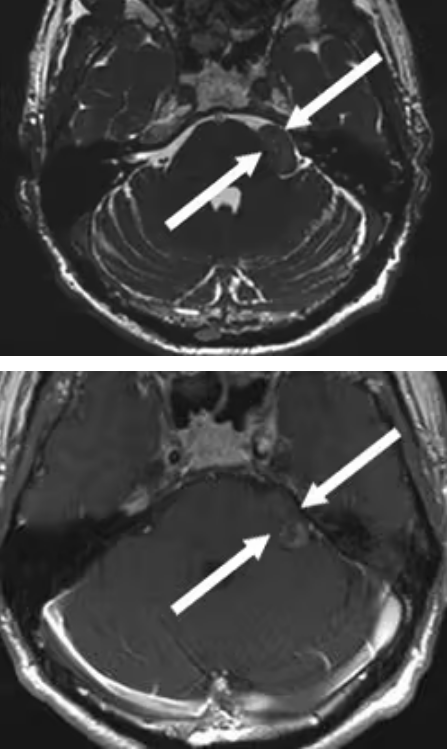
MRI showing a tumor in the patient's cerebellopontine angle region, indicated by the arrow.
Professor Schroeder performed an endoscope-assisted craniotomy. A small cranial opening of approximately 2 × 2.5 cm was made — sufficient to allow instrument access and adequate surgical exposure. Intraoperatively, Professor Schroeder employed a "dual-scope" technique combining the surgical microscope and the neuroendoscope to dissect and remove the tumor from the facial nerve fibers.
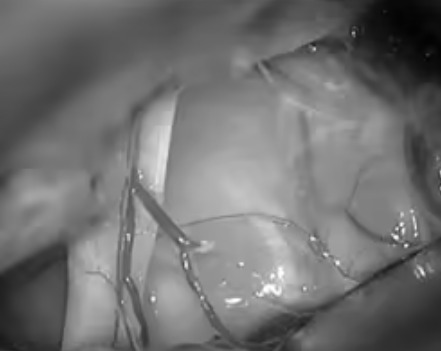
Tumor visualization under the surgical microscope.
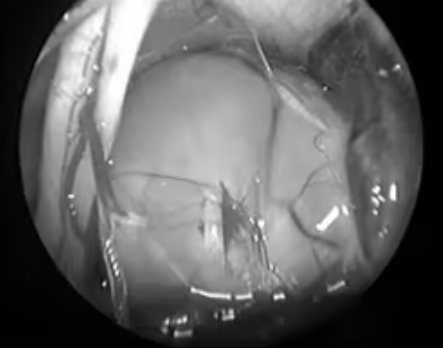
Tumor visualization under the neuroendoscope.
The surgery was successful. Postoperative MRI confirmed complete tumor resection. The patient's hearing was preserved without any deterioration or loss. Furthermore, the preoperative facial numbness resolved completely, and facial sensation returned to normal.
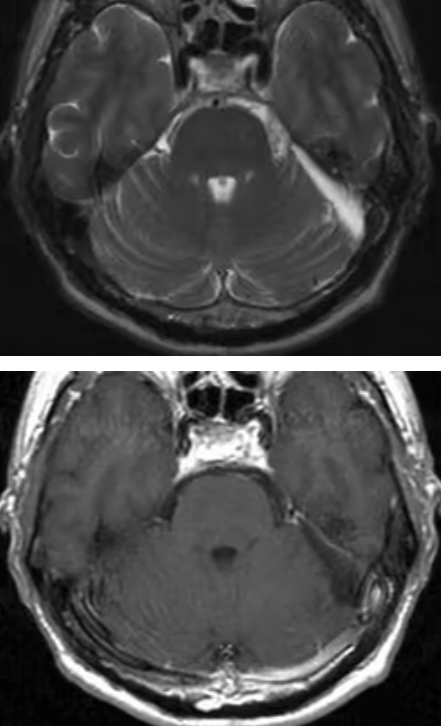
Postoperative MRI confirming complete tumor resection.
Six Key Challenges in Trigeminal Schwannoma Surgery
1. Complex anatomy and difficulty selecting the surgical approach
• Variable location: The tumor may be situated in the middle cranial fossa (Meckel's cave), the posterior cranial fossa (cerebellopontine angle), or spanning both (dumbbell type), each requiring a different surgical approach (e.g., subtemporal, retrosigmoid, or combined).
• Critical adjacent structures: The operative field is in close proximity to the brainstem, internal carotid artery, cavernous sinus, basilar artery, and multiple cranial nerves (including the facial-cochlear complex and trochlear nerve), all of which are at risk of intraoperative injury.
2. Intimate relationship between tumor and neural/vascular structures
• Neural adhesion: The tumor arises from the trigeminal nerve sheath and is often densely adherent to the nerve fibers; attempts at complete resection risk nerve injury, resulting in postoperative facial numbness, masticatory weakness, or loss of corneal sensation (potentially leading to corneal ulceration).
• Vascular encasement: The tumor may encase or displace critical vessels (e.g., basilar artery branches, superior petrosal vein), making dissection prone to hemorrhage or cerebral ischemia.
3. The challenge of functional preservation
• Trigeminal nerve function: Intraoperatively, a balance must be struck between complete tumor removal and nerve function preservation — particularly in younger patients. Subtotal resection may necessitate adjuvant radiotherapy, but at the cost of increased recurrence risk.
• Adjacent cranial nerve injury: The facial-cochlear nerve complex (risking facial palsy and hearing loss) and the trochlear nerve (risking diplopia) are particularly vulnerable.
4. High risk of postoperative complications
• CSF leak: Surgery at the middle cranial fossa floor or petrous bone may disrupt the dura, leading to CSF rhinorrhea or wound leak.
• Intracranial infection or hemorrhage: Prolonged operative time and a wide operative field increase the risk of infection or postoperative hematoma.
• Brainstem injury: Large tumors compressing the brainstem may lead to serious consequences — including respiratory and circulatory compromise — if the brainstem is retracted or its blood supply is disrupted intraoperatively.
5. The tradeoff between recurrence and subtotal resection
• Difficulty of complete resection: When the tumor invades the cavernous sinus or encases vessels, complete resection may not be feasible, requiring postoperative adjuvant radiotherapy (e.g., Gamma Knife).
• Managing recurrence: Recurrent tumors are typically more densely adherent to surrounding structures, making re-operation significantly more challenging.
6. Intraoperative technical demands
• Neurophysiological monitoring: Real-time monitoring of cranial nerve function (trigeminal and facial nerves) is required, though the sensitivity and specificity of available modalities remain limited.
• Endoscopic assistance: Deep operative fields — such as the cavernous sinus — require endoscopic assistance, placing high demands on the surgeon's experience and technical proficiency.
Professor Schroeder's Perspective
"In performing surgical resection, endoscope-assisted microsurgery should be the preferred technique. This approach combines the panoramic visualization of the endoscope with the precision of microsurgical manipulation, providing a clearer and more detailed operative field — enabling the surgeon to identify and distinguish critical anatomical structures with greater confidence.
Furthermore, real-time monitoring of the auditory and facial nerves should be implemented throughout the procedure. This is indispensable for protecting the patient's sensory and motor nerve function. By providing the surgeon with continuous feedback on the functional status of these nerves, intraoperative monitoring enables timely protective measures to be taken, avoiding unnecessary injury to these critical structures."
— Professor Henry W.S. Schroeder INC International Neurosurgical Expert
About Professor Schroeder
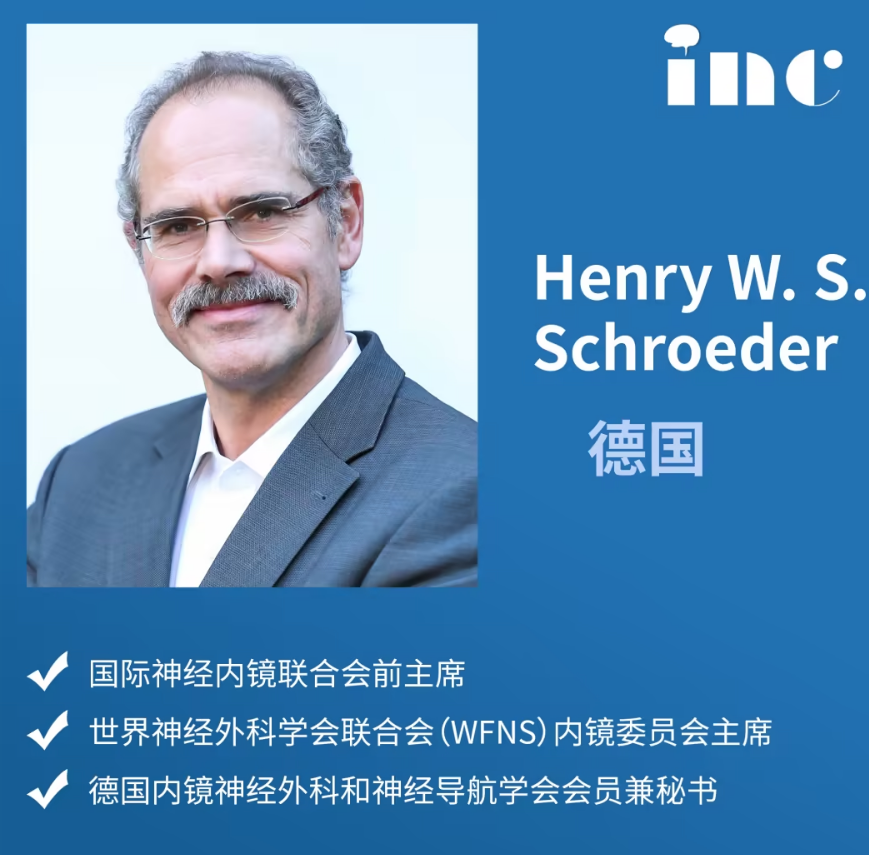
Professor Schroeder brings over 20 years of extensive experience in the diagnosis and surgical treatment of neurosurgical conditions, and holds an international reputation in the field of neuroendoscopic surgery. His areas of expertise encompass endoscopic neurosurgery (hydrocephalus, cysts, intraventricular lesions), endoscopic skull base surgery (meningiomas, vestibular schwannomas, epidermoid cysts), endonasal endoscopic skull base surgery (pituitary adenomas), minimally invasive neuronavigation-guided intracerebral surgery, peripheral nerve surgery, and epilepsy surgery. He is particularly renowned for his minimally invasive single-nostril endoscopic approach to pituitary adenomas. His neuroendoscopic cases — including pituitary adenomas and meningiomas — consistently achieve high resection rates with comparatively low recurrence rates.