2026-06-04
Introduction: Trigeminal schwannoma is a benign tumor arising from the Schwann cells of the trigeminal nerve sheath. Because of its slow growth and deep location, it frequently produces complex symptoms by compressing adjacent neural structures.
Mr. Wang, a 48-year-old patient, presented with left-sided facial numbness and masticatory weakness; cranial MRI revealed a mass in the cerebellopontine angle, and pathological examination confirmed trigeminal schwannoma — a case that illustrates the typical clinical onset of this condition. This article provides a comprehensive analysis spanning pathological mechanisms, clinical symptoms, diagnostic techniques, and treatment and rehabilitation, integrating the latest research and clinical cases to offer patients a thorough diagnostic and therapeutic reference.
I. Nature and Pathological Characteristics
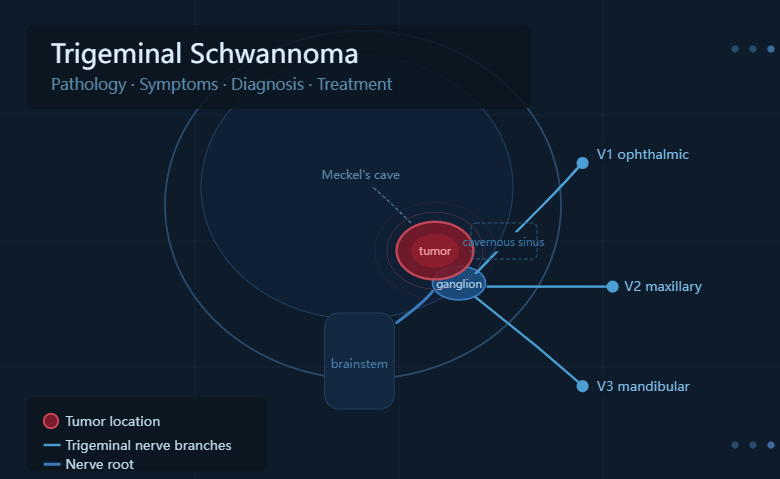
Trigeminal schwannomas account for 5–10% of all intracranial schwannomas, second only to acoustic neuromas. They predominantly affect middle-aged individuals (average age 45–55), with a slight female predominance. The tumor arises from the Schwann cells of the trigeminal nerve and is classified into four types according to location.
(I) Anatomical Classification and Growth Characteristics
Middle Cranial Fossa Type (40%)Originates from the trigeminal ganglion and grows into the middle cranial fossa, compressing the cavernous sinus and temporal lobe. Common symptoms include facial numbness and diplopia.
Cerebellopontine Angle Type (35%)Originates from the trigeminal nerve root and extends into the cerebellopontine angle, resembling an acoustic neuroma; may compress the facial and vestibular nerves.
Transfossa Type (Dumbbell Type, 20%)Involves both the middle and posterior cranial fossae via Meckel's cave, forming a dumbbell configuration; surgical resection is technically demanding.
Other Rare TypesIntraorbital type (compressing the extraocular motor nerves) and extradural type (invading the skull base bone).
(II) Histopathological Features
• Antoni A type: Tumor cells arranged in dense fascicles; prone to cystic degeneration; accounts for 70%.
• Antoni B type: Loosely arranged cells with stromal edema and abundant vascularity; prone to hemorrhage; accounts for 30%.
• Immunohistochemistry: S-100 protein positive (specific marker); GFAP negative (distinguishes from glioma).
(III) Genetic Associations
Approximately 5% of cases are associated with neurofibromatosis type 2 (NF2), presenting as bilateral trigeminal schwannomas or concurrent acoustic neuromas; genetic testing for NF2 mutation is indicated.
II. Clinical Symptoms
The symptoms of trigeminal schwannoma are closely related to the tumor's location and size. Early symptoms are subtle; as the tumor enlarges, progressive multi-nerve compression ensues
(I) Trigeminal Nerve Dysfunction
1. Sensory Disturbance (most common, 85%)
• Facial numbness: The most common initial symptom is unilateral facial numbness, typically beginning near the side of the nose or the lower jaw and gradually spreading throughout the distribution of the trigeminal nerve.
• Sensory loss: Pain and temperature sensation are markedly diminished while touch sensation is preserved — a pattern of "dissociated sensory loss."
• Diminished corneal reflex: When the ophthalmic branch is involved, the ipsilateral corneal reflex is sluggish, predisposing to corneal ulceration (e.g., patients presenting with a foreign body sensation in the eye may be found to have corneal epithelial defects).
2. Motor Dysfunction (50%)
• Masticatory weakness: Involvement of the mandibular branch produces reduced bite force and difficulty eating hard foods.
• Masticatory muscle atrophy: Atrophy of the temporalis and masseter muscles leads to facial asymmetry; palpation reveals thinning of the muscle belly.
3. Trigeminal Neuralgia-Like Pain (20%)
Tumor irritation of the trigeminal nerve root triggers paroxysmal severe pain resembling primary trigeminal neuralgia, but with a poor response to pharmacological treatment.
(II) Symptoms from Compression of Adjacent Structures
1. Raised Intracranial Pressure
When the tumor exceeds 3 cm in diameter and obstructs CSF circulation, headache, vomiting, and papilledema develop; pediatric patients may exhibit the "setting sun" sign.
2. Cranial Nerve Involvement
• Facial nerve (VII): Cerebellopontine angle tumors compressing the facial nerve cause peripheral facial palsy (incomplete eyelid closure, deviation of the mouth angle).
• Vestibular nerve (VIII): Vertigo, tinnitus, and hearing loss develop, requiring differentiation from acoustic neuroma.
• Oculomotor nerve (III) and abducens nerve (VI): Middle cranial fossa tumors compressing the cavernous sinus produce extraocular movement disorders and diplopia.
3. Brainstem Compression
Large tumors compressing the brainstem posteriorly cause limb ataxia and gait instability; in severe cases, hydrocephalus and impaired consciousness may develop.
(III) Special Presentations
• NF2-associated tumors: Bilateral trigeminal schwannomas with hearing loss; vigilance for multiple CNS tumors is required.
• Pregnancy-related tumors: Hormonal changes may stimulate tumor growth, with symptoms worsening during pregnancy and stabilizing postpartum.
III. Diagnostic Workup: Precise Localization with Imaging and Electrophysiology
(I) Imaging Studies
1. Magnetic Resonance Imaging (MRI)
• Middle cranial fossa type: Isointense to hypointense on T1-weighted imaging; hyperintense on T2-weighted imaging; homogeneous contrast enhancement; enlargement of Meckel's cave visible.
• Cerebellopontine angle type: Resembles acoustic neuroma but is connected to the trigeminal nerve; the internal auditory canal is not enlarged (a key distinguishing feature from acoustic neuroma).
• Dumbbell type: Spans the middle and posterior cranial fossae; contrast-enhanced imaging shows "dumbbell-shaped" enhancement; CSF spaces are widened.
2. Computed Tomography (CT)
Bone window settings demonstrate skull base bony erosion (e.g., petrous apex, middle cranial fossa floor); intratumoral calcification is occasionally seen. Contrast-enhanced CT shows homogeneous tumor enhancement with well-defined margins.
3. Digital Subtraction Angiography (DSA)
Used to exclude highly vascularized tumors (e.g., meningioma); demonstrates displacement of the cavernous segment of the internal carotid artery without an abnormal vascular nidus.
(II) Neurophysiological Studies
• Trigeminal nerve conduction velocity: Reduced on the affected side (below 35 m/s) with decreased amplitude.
• Blink reflex testing: Prolonged R1 and R2 latencies indicate ophthalmic branch dysfunction
(III) Differential Diagnosis
| Condition | Key Differentiating Features | Imaging Characteristics |
Acoustic neuroma | Internal auditory canal enlargement; predominantly facial/vestibular nerve symptoms | MRI shows internal auditory canal mass with homogeneous enhancement |
Meningioma | Broad dural base; positive dural tail sign | Homogeneous contrast enhancement; bony hyperostosis |
Trigeminal neuralgia | No mass; no tumor at nerve root | MRI unremarkable; vascular compression common |
Cavernous hemangioma | Mixed signal; hemosiderin deposition | T2WI shows "popcorn sign"; no enhancement |
IV. Treatment: A Surgery-Led Multimodal Approac
(I) Surgery: The First-Line Curative Treatment
1. Surgical Goals and Principles
• Gross total resection (Simpson Grade I): The ideal objective; recurrence rate below 5%; appropriate when tumor margins are well-defined and the brainstem is not invaded.
• Subtotal resection: When the tumor is densely adherent to the brainstem, partial capsule is preserved and postoperative radiotherapy is added; recurrence rate 20–30%.
2. Surgical Approach Selection
| Approach | Indications | Advantages and Risks |
Retrosigmoid approach | Cerebellopontine angle type; dumbbell type | Adequate exposure; low facial nerve injury risk; requires cerebellar retraction |
Middle cranial fossa approach | Middle cranial fossa type; invasion of anterior cavernous sinus wall | Direct exposure of trigeminal ganglion; risk of injury to the vein of Labbé |
Combined approach (middle cranial fossa + retrosigmoid) | Large dumbbell-type tumors spanning middle and posterior fossae | Staged resection; prolonged operative time; higher complication risk |
3. Key Intraoperative Techniques
• Nerve monitoring: Intraoperative facial nerve EMG monitoring reduces the facial palsy rate from 15% to 5%.
• Microsurgical technique: Using 4–5× surgical magnification, sharp dissection is performed at the tumor-nerve interface to protect trigeminal nerve branches.
• CSF management: Opening of the subarachnoid space reduces intracranial pressure and minimizes cerebellar retraction injury.
4. Postoperative Complications
• Facial palsy (10–20%): Transient palsy is managed with neurotrophic agents (e.g., mecobalamin) and physical therapy; permanent palsy may require facial nerve–hypoglossal nerve anastomosis.
• CSF leak (5–10%): Meticulous dural closure intraoperatively, followed by lumbar drainage postoperatively; incidence is lower than with acoustic neuroma surgery.
• Trigeminal nerve functional deterioration: Postoperative facial numbness may worsen and requires long-term follow-up; partial compensation develops in some patients over time.
(II) Radiation Therapy: A Supporting Role
1. Stereotactic Radiosurgery (e.g., Gamma Knife)
Indications:
• Tumor diameter below 3 cm with well-defined margins
• Postoperative residual or recurrent tumor
• Elderly patients or those unable to tolerate surgery
Efficacy: 5-year tumor control rate of 85–90%; trigeminal nerve function preservation rate of 60–70% (Journal of Neurosurgery, 2023).
2. Conventional Radiotherapy
Reserved for patients who cannot receive stereotactic radiosurgery; total dose of 50–54 Gy in 25–27 fractions; carries significant side effects including radiation-induced cerebral edema.
(III) Pharmacological Treatment: Limited to Specific Scenarios
• Targeted therapy: For patients with NF2 gene mutations, mTOR inhibitors (e.g., everolimus) may be considered; efficacy remains under investigation.
• Symptomatic treatment: Carbamazepine may be used short-term for trigeminal neuralgia-like pain, with liver function monitoring required.
V. Perioperative Management and Rehabilitation
(I) Preoperative Assessment
• Neurological baseline: Detailed documentation of facial sensation, masticatory muscle strength, and corneal reflex; BNI facial nerve grading scale used to assess facial nerve function.
• Imaging reconstruction: 3D-CT reconstruction of skull base anatomy for surgical pathway planning.
• Airway assessment: For patients with large tumors compressing the brainstem, intubation difficulty should be anticipated and fiberoptic bronchoscopy prepared.
(II) Key Postoperative Care Measures
1. Neurological Function Monitoring
• Facial sensation: Daily testing of the three trigeminal distribution zones with a cotton swab, compared against the preoperative baseline.
• Corneal protection: For patients with absent corneal reflex, erythromycin eye ointment and an eye shield are applied; artificial tears every 2 hours to prevent exposure keratitis.
2. Complication Surveillance
• Intracranial hematoma: Vigilant monitoring of consciousness and pupillary equality in the first 24 hours postoperatively; unequal pupils suggest possible hematoma and require emergency CT.
• Pneumonia prevention: Patients with masticatory weakness should be protected against aspiration; early repositioning, chest percussion, and encouragement of deep breathing are instituted.
3. Rehabilitation Training
• Masticatory function exercises: Chewing gum beginning 1 week postoperatively (3 times daily, 10 minutes per session) to promote masticatory muscle recovery.
• Facial palsy rehabilitation: Facial expressive muscle training (cheek puffing, brow furrowing) beginning 2 weeks postoperatively, combined with low-frequency electrical stimulation twice daily.
(III) Long-Term Follow-Up
• Imaging surveillance: Contrast-enhanced MRI at 3 months, 1 year, and 2 years postoperatively, then annually to monitor for recurrence.
• Neurophysiological assessment: Annual trigeminal nerve conduction velocity and blink reflex testing to evaluate recovery.
• Pregnancy guidance: Female patients with no recurrence at 1 year postoperatively may consider pregnancy; vigorous head and neck movement should be avoided during pregnancy; MRI follow-up at 3 months postpartum.
VI. Prognostic Factors and Survival Analysis
(I) Survival and Recurrence Rates
• Overall prognosis: Benign tumor; 10-year survival rate exceeds 95% after complete resection; 80–85% for subtotal resection combined with radiotherapy.
• Recurrence risk: Below 5% after complete resection; 20–30% after subtotal resection; recurrent tumors grow relatively quickly (average annual volume increase of 15%).
(II) Factors Influencing Prognosis
• Extent of resection: Simpson Grade I resection carries a significantly lower recurrence rate than Grade II (5% vs. 25%).
• Tumor size: Tumors exceeding 4 cm in diameter have lower GTR rates and higher postoperative complication rates.
• Pathological type: Antoni B type, owing to its abundant vascularity, is associated with greater intraoperative blood loss and lower GTR rates.
(III) Impact on Quality of Life
• Facial sensory disturbance: Approximately 30% of patients are left with mild residual numbness postoperatively, which does not significantly affect daily functioning.
• Masticatory function: 90% of patients recover to their preoperative level within 3–6 months; a small number of severe cases require prosthetic dental assistance.
Frequently Asked Questions
1. What is trigeminal schwannoma?
Trigeminal schwannoma is a benign tumor arising from the Schwann cells of the trigeminal nerve sheath. It grows slowly and can compress the trigeminal nerve and adjacent structures, producing symptoms including facial numbness, masticatory weakness, and diplopia. Surgical resection is the primary treatment.
2. What are the symptoms of trigeminal schwannoma?
• Core symptoms: Unilateral facial numbness, masticatory weakness, diminished corneal reflex.
• Associated symptoms: Headache, diplopia, hearing loss, facial palsy; large tumors may cause hydrocephalus and impaired consciousness.
3. What causes trigeminal schwannoma?
• Sporadic cases: Cause unknown; possibly related to abnormal Schwann cell proliferation.
• Hereditary cases: 5% are associated with NF2 gene mutations, presenting as multiple schwannomas.
4. Is surgery always necessary for trigeminal schwannoma?
• Surgery is indicated when neurological deficits develop (e.g., worsening facial numbness, masticatory weakness), when tumor diameter exceeds 2 cm, or when intracranial pressure is raised.
• Observation is appropriate for tiny asymptomatic tumors (under 1 cm), with MRI surveillance every 1–2 years. Surgery is the only potentially curative treatment; radiotherapy is reserved for patients who cannot undergo surgery.
VIII. Conclusion: Transforming Prognosis in the Microsurgical Era
Although trigeminal schwannoma is a benign tumor, its deep location and proximity to critical neurovascular structures demand a treatment strategy that balances radicality of resection against preservation of function. With advances in microsurgical technique — including nerve monitoring and combined approaches — and the widespread adoption of stereotactic radiosurgery, most patients can now achieve favorable outcomes. For individuals presenting with facial numbness or masticatory disturbance, prompt cranial MRI is the key to early detection. For patients who undergo surgery, structured postoperative follow-up and rehabilitation training minimize lasting sequelae and maximize quality of life.