2026-06-02
Introduction: Diagnosis of intraosseous schwannoma of the occipital bone. Gross total resection of the tumor was achieved, postoperative neurological function remained intact, and the patient was discharged on the first postoperative day. At two-month follow-up, Lili recovered well, with excellent healing of the occipital surgical site and no neurological deficits.
A child's health is always a parent's greatest concern. If a child develops a small unexplained lump on the head, what factors might be responsible? An accidental fall? Or being struck by a heavy object?
In fact, beyond these common causes, there exists a more serious possibility…
The head mass was found to be caused by tumor erosion of the bone.
A small lump appeared on the back of the head of three-year-old Lili. The parents did not pay much attention initially, as the child remained asymptomatic and in good health. However, the mass on the occiput was noticeable. To definitively address this seemingly trivial issue, the parents brought Lili to the hospital for consultation with Professor Rutka.
After a detailed medical history, Professor Rutka found that Lili had no neurological symptoms typical of brain tumors. Apart from past medication for attention-deficit/hyperactivity disorder (ADHD), there was no family history of neurofibromatosis or schwannomatosis.
Examination revealed a solid, approximately 1.2 cm diameter mass on Lili's occiput, covered by hair. The mass was ovoid, moderately firm, non-tender, and non-pulsatile, with intact overlying and surrounding scalp and hair. The remainder of the examination was unremarkable, leaving Lili's parents even more puzzled: what exactly was this mass?
Subsequently, Professor Rutka performed further imaging with magnetic resonance imaging (MRI). MRI showed a well-defined mass involving the midline of the occipital bone. Anteriorly, it abutted the posterior inferior segment of the superior sagittal sinus, causing mild indentation, and posteriorly it caused displacement, but did not invade the overlying scalp soft tissues. There were no abnormalities in the brain parenchyma. CT revealed an irregular intramedullary osteolytic lesion.
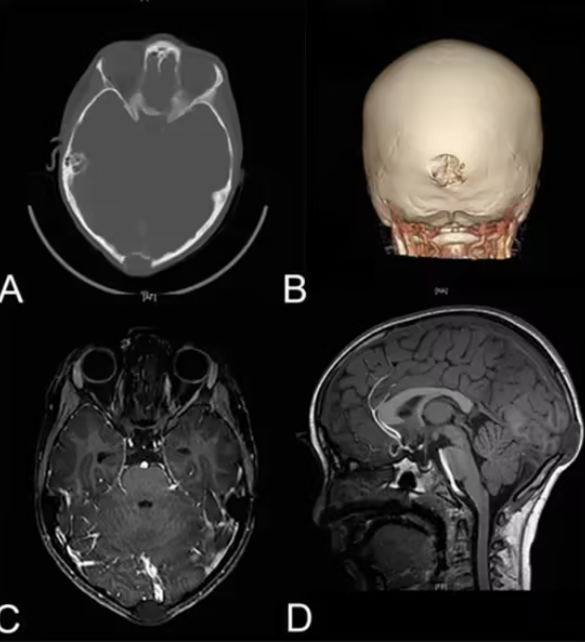
Based on the above imaging findings, Professor Rutka speculated that Lili's head mass could be a dermoid or epidermoid cyst, eosinophilic granuloma, osteoma, or hemangioma. After discussion with the family, it was decided that Professor Rutka would perform surgical resection to establish a definitive diagnosis and achieve postoperative cosmetic restoration.
Postoperative recovery of the child after gross total resection.
Intraoperatively, the lesion was brown-yellow in color and rubbery in consistency. A clear interface existed between the tumor and the normal bone. The inner table of the skull remained intact over the superior sagittal sinus. Histopathological analysis revealed a solid, encapsulated spindle cell tumor growing in interlacing fascicles, with alternating hypercellular and hypocellular areas.
Fragments of bone were present at the margin. The hypercellular areas exhibited palisading nuclei (Antoni A pattern), alternating with hypocellular areas composed of irregularly arranged cells within a loose, edematous stroma (Antoni B pattern).
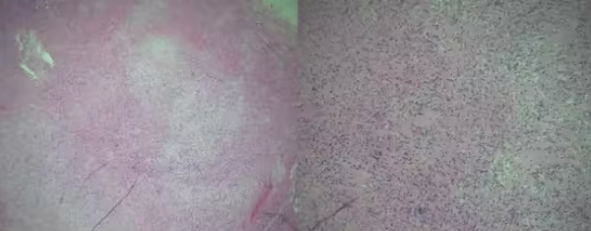
These features collectively supported the diagnosis of intraosseous schwannoma of the occipital bone. Gross total resection of the tumor was achieved. Postoperatively, Lili's neurological function remained intact, and he was discharged on the first postoperative day. At two-month follow-up, Lili recovered well, with excellent healing of the occipital surgical site and no neurological deficits. Thus, the problem was completely resolved, and Lili's parents could finally rest assured.
What is a schwannoma?
A schwannoma is a benign tumor originating from Schwann cells of the cranial or spinal nerves, with extremely rare malignant transformation. Approximately 10% of schwannomas occur in patients with neurofibromatosis type 2, schwannomatosis, or neurofibromatosis type 1.
The most common cranial nerve schwannoma is the vestibular schwannoma arising from the eighth cranial nerve, accounting for 6–8% of intracranial tumors. Schwannomas of other cranial nerves, such as the trigeminal, facial, and lower cranial nerves, are less common, representing 8–10% of intracranial schwannomas.
Intraosseous schwannomas are a relatively rare clinical entity. Most cases involve the mandible, sacrum, or thoracolumbar spine. Preoperative diagnosis is often challenging due to their non-specific clinical symptoms and imaging findings. Patients typically present with mild symptoms, such as a firm, non-tender mass that may be visible through the scalp, similar to Lili's case.
Given the rarity of intraosseous schwannoma, the optimal treatment strategy is not fully standardized. Existing studies suggest that in most cases, complete surgical excision is curative, with patients having good outcomes during follow-up periods ranging from 3 months to 14 years, without local recurrence. Gross total resection is considered an effective treatment for tumors that do not invade adjacent structures. For tumors that cannot be resected, or when there are definite contraindications to surgery, severe comorbid conditions, or neurofibromatosis, stereotactic radiosurgery may be considered.
Case source: James T. Rutka. Intraosseous schwannoma of the occipital bone: a case report. 2018
Content source: Rais, F., Benhmidou, N., Rais, G. et al. Solitary intraosseous schwannoma of the base and vault of the skull: a summary review of such unusual location. Clin Sarcoma Res 5, 6 (2015).