2026-05-29
Introduction: "Diffuse glioma can't be completely resected surgically — so what's the point?" "How long can someone with diffuse glioma actually survive?" Even within the category of diffuse glioma, there are multiple distinct subtypes with dramatically different prognoses.
For glioma patients, the term "diffuse" often carries a sense of hopelessness — typically associated with the impossibility f complete surgical resection and a shortened survival. Many patients ask: "If diffuse glioma cannot be fully removed, what is the purpose of treatment? How long do patients with diffuse glioma actually live?" In reality, even diffuse glioma encompasses a range of distinct subtypes whose prognoses can differ substantially.
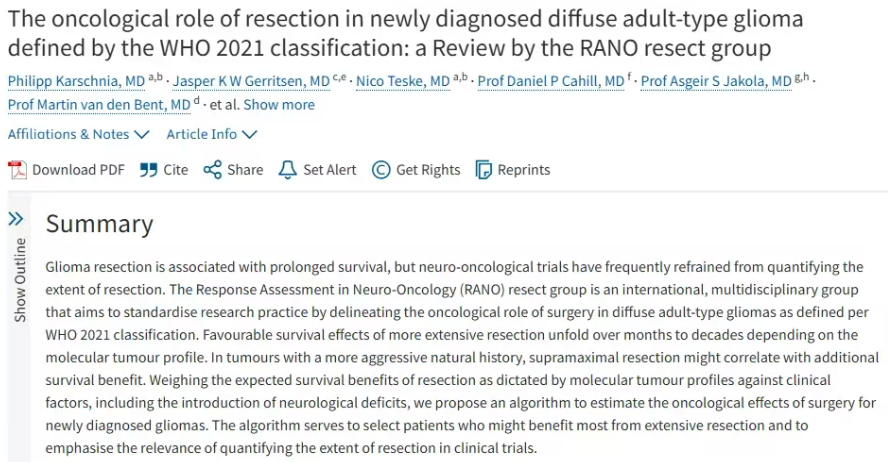
Diffuse glioma is the most common primary intraparenchymal brain tumor in adults. For newly diagnosed disease, surgical resection is recommended as the initial treatment. Surgery serves two purposes: obtaining tissue for neuropathological diagnosis, and extending patient survival. While maximal safe resection is the central surgical objective, the oncological benefit must be carefully weighed against the risk of clinical deterioration in appropriate patient selection, as surgery-induced neurological deficits can offset the gains of more extensive resection.
01 IDH-Wildtype Glioblastoma, CNS WHO Grade 4
Glioblastoma is by far the most common glioma subtype, accounting for approximately 60% of all diffuse gliomas. Median overall survival (mOS) for this tumor type is relatively poor, typically ranging from 12 to 17 months. Although the 2021 WHO Classification of Tumours of the Central Nervous System restricts the diagnosis of glioblastoma to IDH-wildtype tumors, only 5–10% of tumors with glioblastoma-like histology harbor IDH mutations. The median survival outcomes from pre-2021 histologically defined glioblastoma cohorts can therefore be reasonably extrapolated to the current IDH-wildtype glioblastoma population.
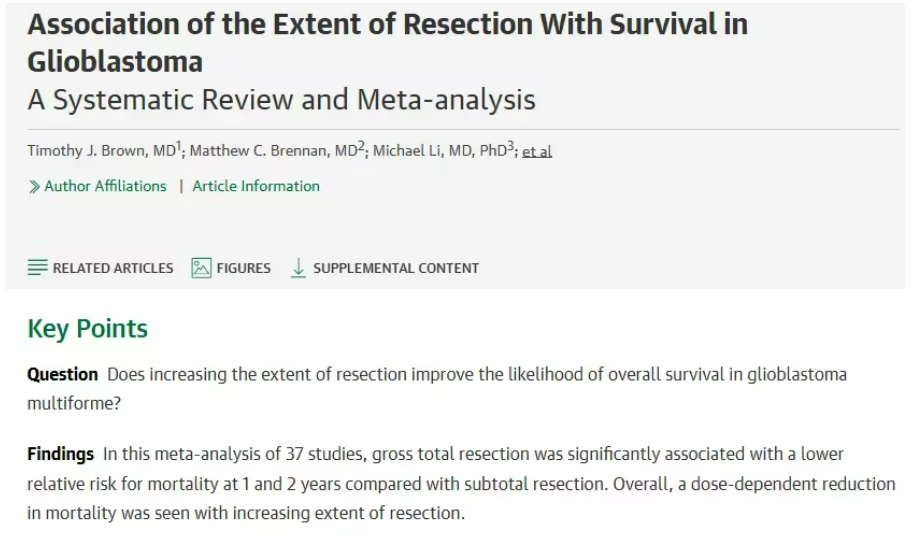
Regarding what proportion of tumor must be resected to confer a survival benefit, earlier studies reported that reduction of the enhancing lesion by approximately 70–90%, or a residual enhancing tumor volume of approximately 5 cm³, carried prognostic significance. One particularly important retrospective cohort study with well-characterized clinical data demonstrated an exponential relationship between residual enhancement and risk of death: Molinaro et al. evaluated 761 glioblastoma patients treated at the University of California between 1997 and 2017 and found that when the extent of resection (EOR) exceeded 80%, relative mortality — normalized to an EOR of 75–80% — decreased significantly, whereas when EOR fell below 40%, relative mortality increased substantially. A meta-analysis encompassing 41,117 glioblastoma cases further supported the superiority of more extensive resection over subtotal resection for improving survival, with biopsy-only patients showing the worst outcomes.
02 IDH-Mutant Astrocytoma, CNS WHO Grade 2–3
IDH-mutant astrocytoma accounts for approximately 15–20% of all diffuse gliomas. Compared to glioblastoma, these tumors generally follow a more indolent course, with mOS reaching 7 to 11 years for Grade 2 and Grade 3 tumors. Whether the distinction between WHO Grade 2 and Grade 3 carries prognostic significance within the molecularly defined IDH-mutant astrocytoma category remains debated, though Grade 2 tumors without enhancement generally carry a more favorable prognosis.
Much of the conceptual framework linking early resection to outcome derives from studies of Grade 2 astrocytoma. Jakola and colleagues reported on 61 patients with IDH-mutant astrocytoma presenting to two Norwegian neuro-oncology centers at a time when treatment strategy was uncertain: Center A favored biopsy alone, while Center B favored surgical resection at the time of new diagnosis. Patients at Center A had an mOS of 5.6 years, while those at Center B who underwent craniotomy and resection achieved an mOS of 10.2 years. Each additional 1 cm³ of residual tumor volume was associated with an estimated HR for death of 1.01. Residual tumor volume exceeding 4.6 cm³ was associated with shorter survival (9.0 years), while patients with smaller residual volumes fared better. Among tumor patients who received chemotherapy, the mOS of the smaller residual volume cohort reached 19.9 years. As the extent of surgical resection increased, the hazard ratios for both overall survival and progression-free survival (PFS) showed a decreasing trend.
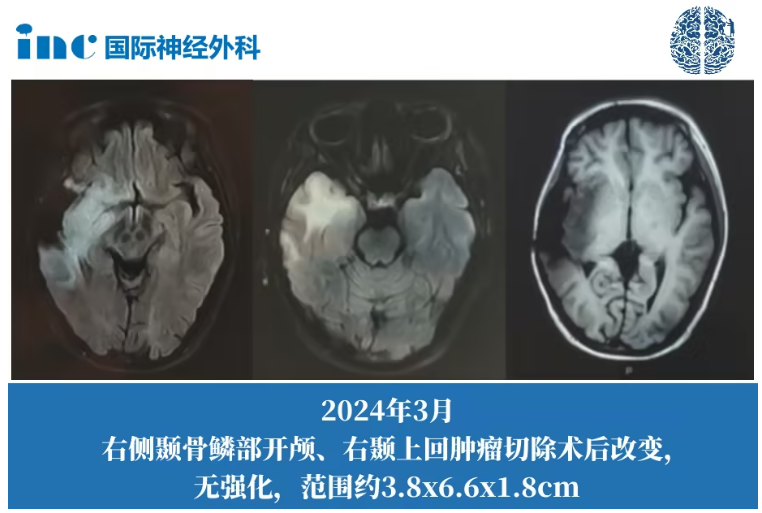
[Clinical case]: A female patient underwent evaluation for left leg numbness and auditory hallucinations, leading to the discovery of a space-occupying lesion in the insula. She subsequently underwent tumor resection; postoperative pathology confirmed a diffuse glioma of the right temporal lobe (astrocytoma, WHO Grade II). Routine follow-up CT demonstrated tumor enlargement, and the patient developed frequent seizures. MRI findings suggested tumor progression or recurrence. Prof. Bertalanffy of INC noted that because the tumor had extended to involve the insula, temporal lobe, and frontal lobe, was of substantial size, and was compressing normal brain tissue, maximal resection would provide decompression and symptom relief. Furthermore, given that the initial postoperative pathology was Grade II, repeat surgery was necessary to determine whether malignant transformation had occurred. Regarding the question of non-surgical alternatives — a concern frequently raised by patients and their families — Prof. Bertalanffy emphasized that the standard treatment paradigm for glioma consists of maximal safe surgical resection followed by adjuvant chemoradiotherapy.
Regarding IDH-mutant astrocytoma Grade 3, Beiko and colleagues reported in a retrospective study that resection of enhancing lesions in 113 patients with IDH-mutant astrocytoma — of whom 86 tumors (76.1%) had Grade 3 histology and 27 (23.9%) had Grade 4 histology — translated into favorable clinical outcomes.
03 IDH-Mutant Astrocytoma, CNS WHO Grade 4
Research has shown that reduction in both enhancing and non-enhancing tumor volume is associated with improved survival. Within cohorts defined prior to the 2021 WHO Classification that carried malignant histological features — classified at the time as glioblastoma — only a small proportion of patients harbored IDH mutations. Under the current classification, detection of homozygous CDKN2A/B deletion permits the diagnosis of IDH-mutant astrocytoma Grade 4 even in the absence of Grade 4 histological features. Additionally, studies such as the Beiko retrospective trial — which included 27 individuals with IDH-mutant, histologically Grade 4 tumors and treated them as glioblastoma — focused exclusively on enhancing lesions. In this context, more extensive resection appears to be associated with favorable outcomes. The mOS for IDH-mutant astrocytoma Grade 4 is 2 to 5 years.
04 IDH-Mutant, 1p/19q-Codeleted Oligodendroglioma, CNS WHO Grade 2–3
Compared to astrocytic tumors, IDH-mutant oligodendroglioma with 1p/19q codeletion is characterized by a protracted natural history, with mOS exceeding 15 years for Grade 2 tumors and exceeding 10 years for Grade 3 tumors. Hervey-Jumper and colleagues studied 190 patients with WHO Grade 2 oligodendroglioma over a median follow-up of 11.7 years and found that residual non-enhancing tumor volume exceeding 4.6 cm³ was associated with a survival of 19.9 years, while patients with smaller residual volumes fared better. Correspondingly, the benefit of more extensive resection for WHO Grade 3 oligodendroglioma patients has also been demonstrated in large studies.
05 Clinical Prognostic Factors That Interact with Surgical Benefit
Surgical technique
One decisive factor in how much of a brain tumor can be resected is the skill of the operating surgeon and the coordination of the surgical team. When tumor location makes complete resection difficult, avoiding unnecessary interventions — or irreversible surgery — during a period of uncertainty can ultimately preserve more options for the patient. For patients with tumors in complex locations, resection is more technically demanding and carries higher risk, requiring an experienced surgical team to define safe operative techniques and approaches. To prevent intraoperative neurological injury, the specific surgical plan must also be adapted based on tumor growth direction and size.
Patient age
Age, treated as a continuous variable, is an independent prognostic marker for IDH-wildtype tumors and, to a lesser extent, for IDH-mutant tumors with or without 1p/19q codeletion. As age increases, overall prognosis is more limited, and physical factors may preclude further non-surgical treatment — particularly in patients over 70. Additional factors that may adversely affect outcome include preoperative Karnofsky Performance Status (KPS), eloquent tumor location, and racial and socioeconomic background.
The role of postoperative adjuvant treatment
Minimizing the risk of postoperative tumor recurrence is a concern for many glioma patients, particularly regarding whether adjuvant chemoradiotherapy is necessary. Postoperative treatment options — both radiotherapy and chemotherapy — carry certain side effects. For high-grade gliomas, postoperative chemoradiotherapy is generally indicated, as the survival benefit substantially outweighs the adverse effects for the vast majority of patients. For low-grade gliomas — primarily Grade 2 and select lower-risk Grade 3 tumors — whether to pursue chemoradiotherapy, radiotherapy alone, chemotherapy alone, or concurrent chemoradiotherapy requires individualized assessment integrating the specific clinical situation, physician experience, and the patient's treatment goals and expectations. Radiotherapy, for example, carries risks of radiation-induced neurotoxicity and cognitive impairment; the balance between these risks and the anticipated survival benefit must be carefully calibrated.
06 Summary
Whether a "diffuse" glioma is amenable to surgery and whether treatment outcomes are likely to be favorable requires comprehensive evaluation integrating the specific pathological subtype, anatomical location, patient symptoms, and the experience of the treating surgeon. In reality, many diffuse gliomas do not have a surgical option; in those cases, appropriate chemoradiotherapy and various targeted therapies become all the more important. Miracles are uncommon — but hope remains.
Reference: https://www.incsg.com/jiaozhiliu/8490.html