2026-05-29
Introduction: On standard contrast-enhanced T1 imaging, both tumor recurrence and radiation necrosis appear as enhancing lesions — similar signal intensity, similar morphology. Conventional sequences alone are often insufficient to tell them apart.
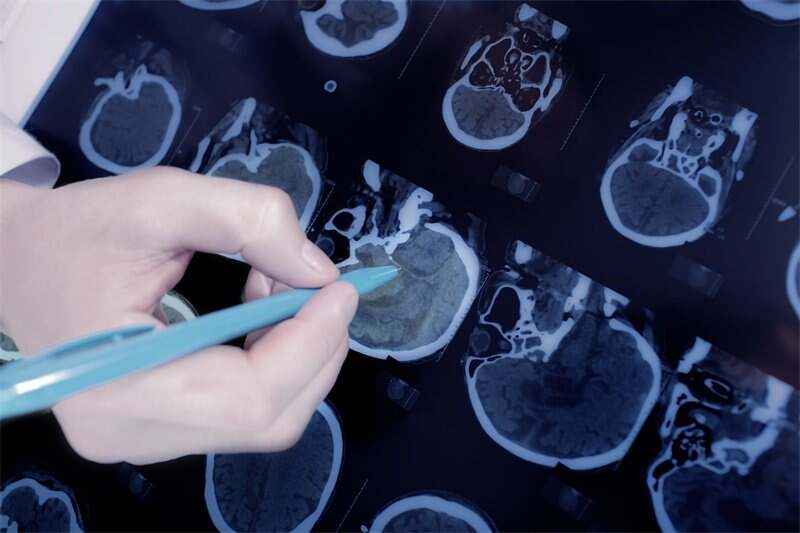
After surgery and concurrent chemoradiotherapy, routine surveillance MRI shows that the latest enhancing lesion is larger than on the previous scan. The family holds up the images and asks: is it a recurrence? Every neurosurgeon who treats glioma has faced this question, and it is never a straightforward one to answer.
The standard postoperative radiotherapy regimen for high-grade glioma is 60 Gy delivered in 30 fractions. While this dose is intended to eliminate residual tumor cells, it simultaneously damages the endothelium of small vessels within normal brain parenchyma, leading to luminal occlusion, focal ischemia, and ultimately radiation necrosis. On standard contrast-enhanced T1 imaging, both tumor recurrence and radiation necrosis present as enhancing lesions — similar signal intensity, similar morphology.
Conventional sequences alone are often insufficient to tell them apart.
Yet the underlying pathophysiology of these two entities is fundamentally opposite. Tumor recurrence reflects reactivation of glioma cells: local demand for blood supply surges, neovascularization proliferates aggressively, the blood-brain barrier breaks down severely, and contrast agent extravasates in large quantities — producing bright enhancement on imaging. Radiation necrosis, by contrast, results from destruction of the microvasculature: blood flow is interrupted, tissue becomes hypoxic and necrotic, and the necrotic tissue also disrupts the blood-brain barrier — hence it too enhances — but the tissue itself is avascular and dead. One process involves excess vascularity; the other, near-complete loss of vascularity. On contrast-enhanced MRI, they look indistinguishable.
Perfusion imaging is the first tool for separating these two entities.
Whether using DSC (Dynamic Susceptibility Contrast) or ASL (Arterial Spin Labeling), both techniques measure the volume of blood flowing through a region of tissue per unit time. Tumor recurrence is hyperperfused — relative cerebral blood volume (rCBV) typically exceeds 1.75, because the tumor is actively recruiting vascular supply. Radiation necrosis is hypoperfused — rCBV is often below 1.0, because the damaged microvasculature cannot carry blood through the tissue. This is not a subtle difference; the two conditions point in opposite directions. Some centers lack perfusion postprocessing software or technical staff experienced with these sequences. When postoperative enhancing lesions cannot be characterized locally, referral to a center with perfusion capability is far more useful than guessing.
The second definitive criterion is methionine PET (MET-PET).
MET-PET measures amino acid metabolic activity. Tumor cells require large quantities of methionine for cell division, so areas of recurrence demonstrate high tracer uptake — the tumor-to-background ratio generally exceeds 1.3–1.5, depending on the center's cutoff. Radiation necrosis consists of metabolically inert dead tissue, with no such demand, and shows low uptake. The specificity of MET-PET is somewhat higher than that of perfusion MRI, but scanners are scarce and not available at every center — patients sometimes have to travel to another province. That said, when an enhancing lesion has indeterminate margins or when perfusion values fall in the gray zone, the trip is genuinely worthwhile.
Symptoms are sometimes the earliest indicator.
Patients with mild radiation necrosis are often asymptomatic — the enhancing lesion is discovered incidentally on surveillance imaging. Tumor recurrence, by contrast, tends to announce itself: as tumor cells repopulate and compress surrounding brain tissue, patients report headache, new-onset seizures, or progressive limb weakness, one symptom after another. The reverse situation does occur, however — extensive radiation necrosis with severe surrounding edema can itself produce hemiplegia and aphasia — at which point symptoms alone are misleading. Symptoms therefore serve as supporting evidence, not as a definitive criterion. But when a patient's scan shows new enhancement, perfusion is elevated, and new neurological symptoms have emerged, the probability of recurrence becomes very high.
Even with all three modalities, a minority of cases remain indeterminate.
Perfusion hovers around 1.5, MET-PET uptake is neither clearly elevated nor suppressed, and symptoms are ambiguous. At this point, the neurosurgeon faces a very practical decision: perform a reoperation for tissue biopsy, or schedule short-interval follow-up imaging and let the lesion declare itself over time. Biopsy is the gold standard — but no one wants to operate again on a patient who has just completed chemoradiotherapy. Short-interval surveillance carries its own risk: if the lesion truly is a recurrence, a two-month delay may forfeit the window for early intervention.
In clinic, I have seen enhancing lesions that gradually shrank and eventually disappeared. I have also seen lesions that enlarged significantly within a month. So the last resort is not something any investigation can resolve — it is resolved by time. Perfusion values from radiology, metabolic values from PET, and the patient's own account of symptoms: when these three are integrated, the answer is clear in roughly eight or nine out of ten cases. For the remaining one or two out of ten, a six-to-eight week follow-up window is set, another MRI is obtained, and the lesion is watched. If it has grown, it is treated as recurrence. If it is stable or smaller, it is managed as necrosis. Sometimes it takes two or three rounds of follow-up imaging before the answer finally stands in front of you.
Reference: https://www.incsg.com/jiaozhiliu/8497.html