2026-05-26
Introduction: Schwannomas are among the most common benign skull base tumors and originate from the nerve sheath cells of cranial nerves located in the cerebellar and brainstem regions. The most common clinical subtypes include vestibular schwannoma (acoustic neuroma) arising from the eighth cranial nerve and trigeminal schwannoma arising from the fifth cranial nerve.
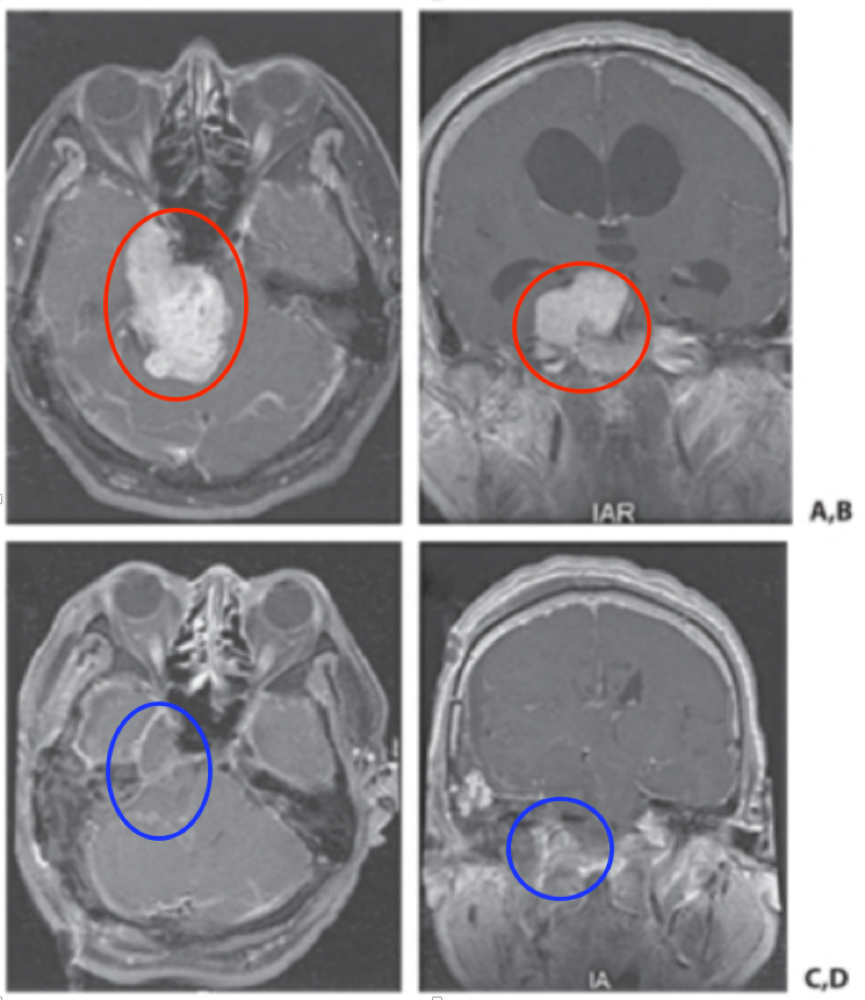
In general, trigeminal schwannomas are associated with a favorable prognosis. However, when the tumor becomes large and compresses the brainstem, the technical difficulty and surgical risk increase substantially, placing high demands on the neurosurgeon’s expertise. William T. Couldwell, a member of the INC International Neurosurgical Advisory Board, described a representative case of complete resection of a giant brainstem-compressing trigeminal schwannoma in his publication Skull Base Tumors: Surgery Perspective.
Surgical Management of a Giant Trigeminal Schwannoma Adjacent to the Brainstem
Preoperative evaluation involved a 54-year-old male patient who presented with progressive gait instability and sudden-onset vertigo. Imaging studies revealed a giant trigeminal schwannoma adjacent to the brainstem. Preoperative MRI demonstrated the characteristic “dumbbell-shaped” morphology commonly associated with trigeminal schwannomas extending across multiple cranial compartments.
Because the tumor compressed the brainstem and extended across both the middle and posterior cranial fossae, surgical treatment carried significant risks of neurological injury and incomplete resection. Multiple hospitals considered the lesion technically challenging to treat. Ultimately, Professor Couldwell’s team successfully achieved gross total resection using a combined petrosal approach, and postoperative MRI confirmed complete tumor removal.
Clinical Management Strategies for Trigeminal Schwannoma
Selection of the initial treatment strategy is critically important in the management of trigeminal schwannoma. Inappropriate treatment not only fails to relieve symptoms but may also increase the complexity of subsequent interventions. Treatment planning should comprehensively consider factors such as patient age, symptom type and severity, and tumor size.
Early diagnosis and intervention are particularly important because progressive tumor enlargement increases surgical difficulty and may compress adjacent structures, resulting in symptoms such as facial paralysis, gait instability, and hearing impairment. Surgery for large trigeminal schwannomas is especially challenging because of the unique anatomy of the trigeminal nerve.
The trigeminal nerve originates from the brainstem, traverses multiple skull base foramina, and extends deeply throughout the cranial base. Along its course, it lies in close proximity to the brainstem, cavernous sinus, internal carotid artery, and multiple cranial nerves.
Available surgical approaches include anterior approaches, lateral approaches, posterior approaches, subdural approaches, extradural approaches, and interdural approaches. The optimal technique depends on tumor size and anatomical location, and these procedures place high demands on both surgical equipment and the technical experience of the operating neurosurgeon.
Professor Couldwell on the Evolution of Skull Base Tumor Surgery
Professor William T. Couldwell has emphasized that skull base tumors are often intimately associated with surrounding neurovascular structures, making complete resection technically demanding. Because these tumors may extend into adjacent anatomical compartments and involve both intracranial and extracranial structures, multidisciplinary treatment strategies are frequently required.
Over the past two decades, advances in microsurgical techniques, modern skull base approaches, electrophysiological monitoring, and neuroimaging have enabled the safe resection of many tumors previously considered inoperable through the application of nerve-preservation techniques. Microsurgery combined with skull base surgical techniques maximizes operative exposure, minimizes brain retraction, and provides multidirectional surgical visualization.
In recent years, the application of frameless stereotactic navigation systems and endoscopic techniques has further advanced modern skull base surgery. The central objective of skull base tumor surgery is to achieve the optimal balance between maximal tumor resection and maximal preservation of neurological function, thereby minimizing postoperative complications while ensuring effective treatment of the lesion.