
2026-01-12
A mother from Huizhou, Guangdong (referred to as Li), was giving her 7-year-old son (referred to as Chen) a bath one evening when she noticed something unusual: his right scrotum appeared larger than normal, feeling soft like a small fluid-filled sac. Strangely, the swelling would disappear by morning, only to return later. This recurring pattern prompted her to seek consultation at the Urology Department of Guangdong Pharmaceutical University Guangzhou Fuxing Chancheng Hospital (Guangzhou Xinshi Hospital). An ultrasound examination confirmed a diagnosis of right-sided communicating hydrocele, requiring surgical intervention.
1. What is a Communicating Hydrocele?
In simple terms, it results from a small, persistent passage that failed to close properly during a boy's development. During fetal development, the testicles descend from the abdomen into the scrotum, bringing down a tubular structure called the processus vaginalis. Normally, this channel closes on its own around the time of birth, sealing off the connection between the abdominal cavity and the scrotum.
If this channel remains partially open, it creates a "small passageway." Peritoneal fluid from the abdomen can then flow through this passage and accumulate in the tunica vaginalis surrounding the testicle, causing scrotal swelling. Because the fluid can move back and forth through this "communicating" channel, the condition is termed a communicating hydrocele.
Considering the child's young age and the importance of cosmetic outcomes, the medical team decided on a minimally invasive approach: laparoscopic high ligation of the patent processus vaginalis. Led by Director Song Shengsheng, the procedure was remarkably smooth and successfully completed in just 10 minutes. Director Song also performed cosmetic suturing to help achieve a nearly "scarless" healing result.
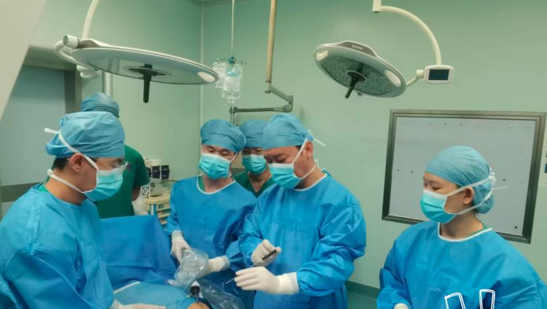
The young patient was able to get out of bed and move around on the evening of the surgery. After an overnight observation with no discomfort, he was discharged smoothly the next day. His mother was deeply impressed by the speed of the surgery and the rapid recovery.
2. Health Reminders on Communicating Hydrocele
The Urology Department of Guangdong Pharmaceutical University Guangzhou Fuxing Chancheng Hospital offers the following key reminders for parents:
·Understand the Core Principle: The condition does not resolve spontaneously after the age of 2. Surgery is the definitive and only curative treatment.
·Learn Daily Observation: Observe changes in size. A classic sign of a communicating hydrocele is that the scrotum appears larger after daytime activity and smaller upon waking in the morning. Parents can watch for this pattern.
·Recognize Emergency Signs: Be alert if the swelling suddenly becomes hard, irreducible, and is accompanied by child distress, vomiting, or pain. This may indicate a strangulated hernia (where a loop of intestine is trapped) or testicular torsion, both of which require immediate medical attention.
·Clarify the Surgical Goal: It is a minor, minimally invasive procedure. The sole purpose is to "close the passageway."
·Correct a Common Misconception: The surgery is performed to protect future fertility. Long-term pressure from a hydrocele can impair normal testicular development.